Introduction to plan consent (non-qualified person submission)
Non-Qualified Person (non-QP) submissions are submissions made where the applicant is not a registered architect or engineer. Proposals which can be submitted by a non-QP include:
- Continued use of premises (e.g. dormitory, canteen, etc.)
- Change of use (without A&A works)
- Electrical works
- Plumbing & sanitary works
- Laying of telco/fibre cables to tenanted unit
- Solar deployment
- Installation of signages in front of tenanted unit
Submission requirements
| Forms | |
|
Cover letter |
Provide a summary of your proposed development. You can include explanations or information to support your proposal. |
| Application for assumption of liability form |
If the proposal involves an increase in GFA and/ or a change from lower value use to higher value use that exceed the development baseline, for which Land Betterment Charge (LBC), development charge, different premium, levy is payable, the Application for Assumption of Liability form (“Form”) and Letter of Consent (to allow JTC to submit the Form to SLA on behalf of the applicant) shall be submitted together with your proposal to JTC. Please refer to the drop down ‘Proposals involving land betterment charge’ for more information. |
| Letter of consent | |
| Authorisation letter from JTC’s tenant/lessee (when the proposed works are not commissioned by JTC’s tenant/lessee) | The authorization letter from Lessee/Tenant Company Name shall be:
|
| Self-declaration form |
The self-declaration form "JTC_LPD_SD_NonQP.XDFX" can be downloaded from CORENET 2.0, navigate to "Submissions", select "Online Submission", choose "JTC", click the dropdown arrow for additional options. The declaration page to be stamped and signed by the lessee/tenant, please save this page in PDF format. When submitting, please submit both documents (XFDX and PDF). |
| Drawings |
|
|
Proposal drawings to be submitted |
|
Guidelines for space/land submissions
Space submissions
This refers to submissions for units within Multi-User Factory (MUF) developments on JTC land.
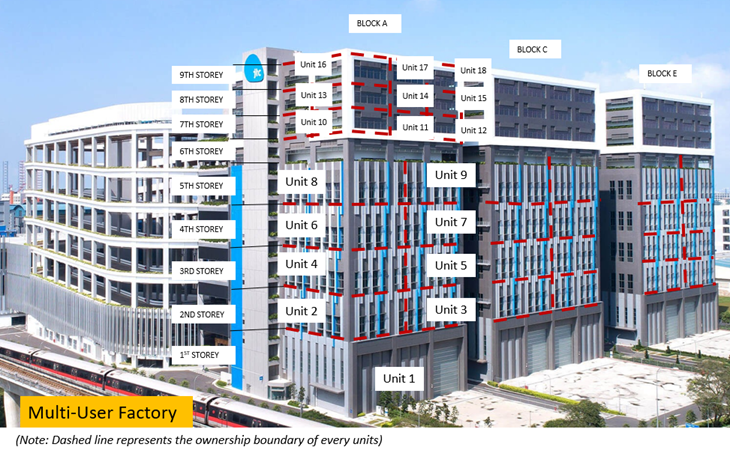
- Proposals where JTC’s consent is not required can be found in List A of the Space Submission Handbook. For cases where JTC landowner’s consent is not required, you will be required to seek the necessary approvals as required by the relevant authorities (e.g. SCDF).
- Please refer to List B of the Space Submission Handbook to determine if QP endorsement is required for the scope of works.
- Please refer to List C of the Space Submission Handbook for buildings with Performance Based Design and List D for Buildings with Green Building Obligations.
For proposals that require fitting out and renovation works, please click here for the process to follow.
Land submissions
This refers to submissions for industrial land, including land with JTC Single-User Factory (SUF), Standard Factory and Terraced Workshop Factory developments.
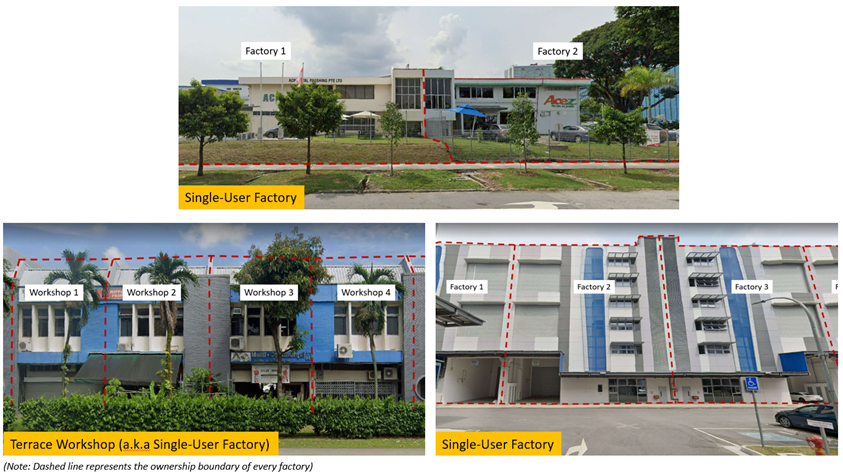
Not all proposals require JTC's consent. For proposals that do not require JTC's consent, please see Annex A and remember to seek the necessary approvals as required by the relevant authorities (e.g. SCDF).
Enterprise district lodgment submissions
Submissions within the Enterprise Districts (ED) have a different process. Please click here to see if your proposal falls within the locations of the EDs.
All proposals within the ED should be lodged unless:
- The proposal does not meet the ED lodgment requirements. For more information on the ED lodgment requirements, please refer to the Enterprise District Lodgment Conditions.
- The submission involves Factory Converted Dormitory (FCD) proposal. Please make a separate submission for the FCD under non-lodgment.
Note: For proposals within the EDs, please pre-consult your Customer Engagement Officer before submitting the proposal to JTC. To find out who your customer engagement officer is, please contact us.
[New] Planning authorisation for change of use of commercial premises in business park developments
From 2 February 2026, change of use within approved commercial premises in business park developments on JTC land to another commercial use or to specific community uses (such as family service centres and childcare centres), will no longer require a change of use application to the Urban Redevelopment Authority (URA).
Applicants will only need to:
- Obtain prior consent from JTC as landowner/landlord
- Fulfil the applicable authorisation conditions
- Obtain the necessary clearances and licences from relevant agencies before commencing the use
Please refer to URA’s circular for the detailed authorisation conditions and requirements.
Proposals involving specific works
Dormitory
To find out more about conversion to workers' dormitories, please click here.
Please refer to the Guide for Submission involving Dormitory to guide you on the requirements of the dormitory submission.
Diesel and petroleum & flammable material (P&FM) storage / health & safety
For renewal of approved diesel tanks, CORENET 2.0 submission to JTC is not required. Please liaise directly with the customer engagement officer to obtain an email approval.
Solar deployment
To find out more about installation of solar photovoltaic (PV) panels, please click here.
- In your submission, please include the autoCAD drawings (.DWG) of the PV and Lightning Protection System (LPS) layout plans.
- In the drawings, please show the PV elevation and section with details in relation to the building. Please also show the highest existing and proposed platform/floor level (i.e. Singapore Height Datum).
- PV Layout (to reflect the shape / area of the proposal) should be provided on the Site Plan.
- On the Site Plan, please reflect the PV Attributes table with the following information:
| Size of solar panel_mm |
| Depth of solar panel_mm |
| Installation angle _deg |
| No. of panels |
| PV_Capacity_DC_kWp |
| PV_Capacity_AC_kWac |
| Total weight_kg |
| Area Occupied_sqm |
Electric vehicles (EV) chargers deployment
If you are keen to deploy EV chargers within your leased/tenanted premises, please consult your JTC Customer Engagement Officer to seek approval for deployment.
Proposals involving land betterment charge
SLA’s Land Betterment Charge (LBC) Act
- With effect from 1 August 2022, a new Land Betterment Charge (LBC) has replaced Differential Premium (DP), Development Charge (DC) and Temporary Development Levy (TDL), which were previously administered by the Singapore Land Authority (SLA) and Urban Redevelopment Authority (URA) respectively. The LBC is a tax on the increase in value of land arising from a chargeable consent (e.g. planning permission) given in relation to a development of any land, and is administered by SLA.
- Under the LBC process, landowners seeking to develop their sites need not make a separate application to SLA for the payment of LBC once a planning application or plan lodgement for an authorised development has been submitted to URA. If a proposed development results in an increase in land value, SLA will follow up directly with the taxable person by issuing a Liability Order (LO) stating the LBC payable. Payment must be made to SLA within 1 month from the date of the LO. This will apply to all planning permissions, plan lodgment and variation of restrictive covenants granted on or after 1 August 2022.
- Landowners are the default party liable for LBC. However, for proposals where the increase in value of land arises from their lessees’/ tenants’ or their subtenants’ (“applicant”) proposals, SLA gives landowners the legal option to transfer this liability to the applicant. To effect this transfer, the LBC Act requires the applicant to fill in the Notice of Assumption of Liability Form (“Form”) and thereafter JTC to submit the Form to SLA. Upon SLA’s acknowledgement, SLA will then issue the Liability Order (LO) to the applicant. Following the payment of the LBC to SLA, URA will then issue the planning permission for the applicant to proceed with their proposals.
- This new process has additional steps of forms-filling to effect the LBC liability onto the correct party, hence may take more time before URA’s Written Permission is released to the applicant (compared to the process pre-1 Aug 22). Hence, to shorten the time that JTC lessees/tenants can get URA’s Written Permission, applicants are encouraged to complete and submit the completed Form as part of your Plan Consent submission via the Corenet, to JTC upfront. Applicants also need to provide a Letter of Consent (as shown below) for JTC to forward the completed Form to SLA. The Letter of Consent will have to be on the applicants’ company letterhead, dated and signed off. This additional paragraph can also be added into the company’s cover letter to JTC for Plan Consent submissions, if you do not want to have a separate letter. When SLA informs JTC about the relevant proposals that incur LBC, JTC will forward the applicants’ completed Form and Letter of Consent to SLA directly. JTC will concurrently alert applicants of the payment, so that applicants can keep a look out for the LO issued by SLA.
|
I, <Designation> <Name of lessee/tenant>, of <Company’s name> grant consent to JTC to forward the “Notice of Assumption of Liability” form to SLA, in the event LBC is payable arising from the planning application. |
- Please also note that lessees/ tenants will be required to complete and submit a new Form whenever there are changes to the Project Title and for every development proposal of the site. Upon receipt of the LO from SLA, should lessees/ tenants decide not to pay the LBC, the proposal will be considered to be aborted, the earlier-completed Form sent to JTC becomes invalid and URA will not follow up with the issuance of the planning permission.
- Applicant (lessee/ subtenant/QP) is advised to do a preliminary check if the proposal will result in any land betterment charge payable, via SLA’s online LBC calculator on OneMap.
- For applications submitted by a subtenant of JTC’s main lessee where the proposal results in payment of LBC, the party to pay LBC is a private arrangement to be agreed upon between the subtenant and the main lessee.
For full details, please refer to SLA's website Lease Managements | Singapore Land Authority.